When Disciplines Collide: How Cross-Specialty Collaboration Unlocks Studio Work That No Single Expert Could Achieve Alone

There is a comfortable assumption embedded in how most creative studios are structured: that the best work comes from the best specialists, each operating at the peak of their individual craft. A photographer lights and frames. A copywriter crafts language. A strategist maps the audience journey. Each professional stays in their lane, and the client receives a polished, compartmentalized result.
But something curious happens when those lanes dissolve.
When a photographer sits down with a sound designer before a single shot is taken, or when a videographer collaborates with a brand copywriter during the conceptual phase rather than the delivery phase, the work that emerges is frequently unlike anything either party would have produced independently. It carries a quality that resists easy categorization—a coherence that feels less assembled and more discovered.
At Goyal's Studio, we have come to regard this phenomenon not as a happy accident, but as a deliberate strategy.
The Friction That Produces Clarity
Collaboration across disciplines is rarely frictionless. In fact, the friction itself is often the point.
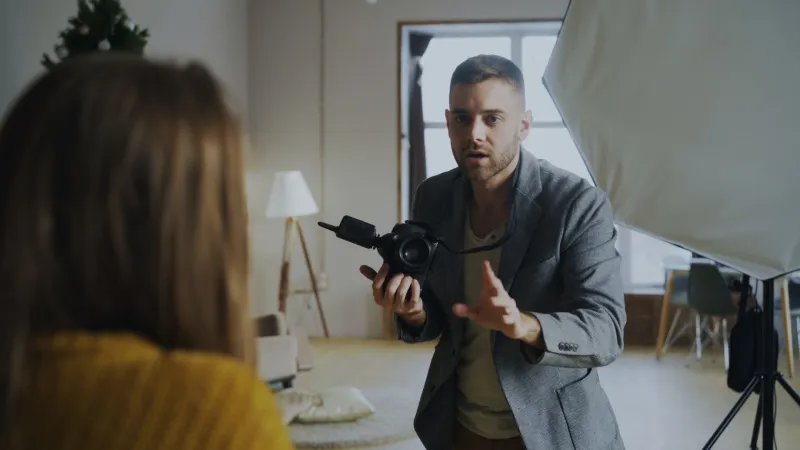
Consider what happens when a commercial photographer and a brand strategist begin a project in the same room, at the same table, before a single concept is approved. The photographer thinks spatially—in light, shadow, negative space, and texture. The strategist thinks sequentially—in audience psychology, message hierarchy, and conversion pathways. These are not naturally compatible modes of thought, and the initial conversations can feel inefficient, even frustrating.
Yet that very discomfort forces both parties to articulate assumptions they would otherwise leave unspoken. The photographer must explain why a particular framing choice carries emotional weight. The strategist must translate abstract audience data into something a visual artist can actually use. Neither professional leaves that conversation unchanged.
In one recent project at our studio involving a regional lifestyle brand based in the Pacific Northwest, a lead photographer and a copywriter were paired from the project's earliest concepting stage—an unusual arrangement that the client initially questioned. The copywriter began drafting narrative fragments not for captions or headlines, but as emotional prompts for the photographer to interpret visually. The result was a campaign whose images and language shared an internal logic so consistent that test audiences described the brand as feeling "like it was made by one very thoughtful person." It was not. It was made by two very different professionals who had been willing to work uncomfortably close to each other's territory.
Where Most Studios Get It Wrong
The standard studio workflow tends to be sequential rather than concurrent. A creative brief is written, passed to a photographer or videographer, executed, then handed to a designer or editor, and finally reviewed by a strategist or account lead. Each hand-off introduces a layer of interpretation—and a layer of distance from the original intent.
This structure is efficient, but it is also insulating. Specialists never have to justify their choices to someone who thinks entirely differently. The photographer's framing decisions are evaluated by other photographers. The copywriter's language is reviewed by other writers. The work becomes internally coherent within each discipline while remaining largely disconnected from the other disciplines surrounding it.
The paradox is that this efficiency often produces work that is technically competent but creatively inert—work that functions correctly but does not resonate deeply. The seams between disciplines are visible to audiences even when they cannot name what they are seeing.
Designing Collaboration With Intention
Not all cross-disciplinary collaboration is equally productive. Throwing specialists into a room and hoping for creative chemistry is not a strategy—it is an experiment with unpredictable outcomes.
The studios producing the most consistently compelling cross-disciplinary work tend to structure collaboration with deliberate care. A few principles have proven particularly reliable in our experience.
Overlap at the concept stage, not the delivery stage. The highest-value moment for cross-disciplinary input is before significant creative decisions have been made. Once a photographer has established a visual direction or a videographer has committed to a narrative structure, the cost of outside input rises sharply. Bringing a copywriter or sound designer into the process early—when ideas are still malleable—allows their perspective to genuinely shape the work rather than merely respond to it.
Establish a shared vocabulary before the work begins. Designers speak in terms of hierarchy and whitespace. Videographers speak in terms of pacing and coverage. Strategists speak in terms of intent and behavior. When these groups collaborate without a shared language, conversations become lengthy translations rather than genuine exchanges. A brief thirty-minute vocabulary session at the project's outset—where each specialist explains how they describe their core concerns—can reduce miscommunication significantly across the entire project timeline.
Protect the discomfort. There is a natural instinct, particularly in client-facing environments, to smooth over the rough edges of cross-disciplinary collaboration—to present a unified front before consensus has actually been reached. This instinct should be resisted. The productive tension between a photographer's visual instincts and a strategist's audience data is not a problem to be managed. It is the mechanism through which genuinely original solutions emerge.
The Unexpected Teacher
One of the more underappreciated benefits of cross-disciplinary collaboration is what it does to each specialist individually over time.
A videographer who regularly works alongside brand strategists begins to internalize questions that do not come naturally to the craft-focused mind: Who is watching this, and under what circumstances? What should they feel thirty seconds after the video ends? How does this content serve a longer commercial relationship?
A photographer who collaborates consistently with sound designers begins to think about rhythm in a new way—not sonic rhythm, but visual rhythm, the pacing of information within a still frame, the way a viewer's eye moves through an image the way an ear moves through a piece of music.
These are not small refinements. They represent a genuine expansion of creative intelligence, and they compound over time. The specialist who has worked across disciplines for several years thinks differently than one who has remained within the comfortable boundaries of their training. Their work reflects that difference in ways that are difficult to quantify but immediately recognizable.
Vision Across Boundaries
At Goyal's Studio, our belief is that the frame—whether photographic, cinematic, or conceptual—is always larger than any single discipline can fill alone. The most enduring visual work we have produced has emerged not from mastery operating in isolation, but from mastery in conversation with other forms of mastery.
The collaboration paradox is real: the best studio work often requires professionals to become, temporarily, students again—to enter territory where they are not the expert, to ask questions that feel elementary, and to allow someone else's expertise to reshape their own. It is an uncomfortable posture for accomplished specialists. It is also, in our experience, an extraordinarily productive one.
For studios and clients alike, the question is no longer whether cross-disciplinary collaboration produces better work. The evidence on that point is fairly consistent. The more relevant question is whether the structures, timelines, and creative cultures currently in place are actually designed to support it—or whether they are quietly working against it.